If I weren’t so lazy, I would consult AP Style on the best way to write that title. But does it really matter in the post-modern blog writing world? Does a Creative Commons License impute a creative license? And while we’re asking such existential questions, is there such a thing as a free lunch?
All you highrollers out there will say, “Yes! I get it all the time.” Then I’ll say, “Really? Really.” And after some thought you’ll say, well, maybe not.
Yes, that highroller comp strategy is nothing new. Saloons in the late 19th century actually practiced it to encourage high-margin liquor sales. The lunch was the lure to liquor. The way to the well. The link to the drink. You get the idea. Hence, “There ain’t no such thing as a free lunch.”
But before you Friedman fans start rejoicing, maybe its not always true. Maybe, just maybe sometimes, Virginia, there is such a thing as a free lunch! Really? Really.
I know a lot of you are Panera fans. Coffee. Internet. Conference Rooms. What’s not to love? You can conduct your whole business from there.
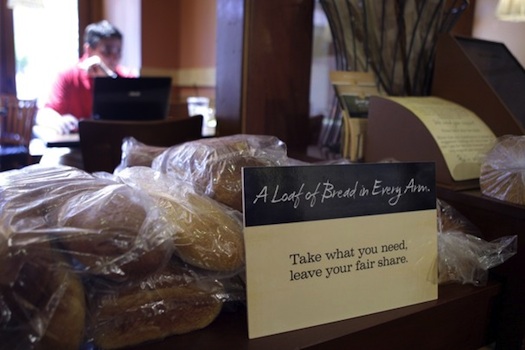
You’ll love Panera even more now that it has entered the Fast Company-sexy world of “Social Enterprise” and “Corporate Social Responsibility”– the chain opened its first nonprofit branch in Clayton, Missouri where you can “pay what you want” for food. Now before you accuse the Clayton Economic Development Committee of tourism-boosting stunts like providing Panera subsidies, no such thing has occurred. And the experiment has proven successful. Panera plans to open two more branches soon and one a quarter thereafter. How does the model work? It has shaken out that “20 percent of his free café’s customers leave more money than the suggested donation, while 20 percent pay less.” And some of those who can’t pay have made it evolve into a co-op, they “have volunteered to work at the restaurant, thus helping cut costs in the only way they can.”
“The key…was opening shops in diverse communities in which richer people could help defray the costs for their poorer neighbors…replaced cashiers with donation boxes so nobody would feel ashamed of being too generous or needy. The result is socialism that really works, not to mention a lot of families who didn’t have to go without food when they needed it most.”
“Panera. Socialism that really works.” – now that’s a slogan. Don Draper could not have done better. Socialism is the new capitalism. Who woulda thought? Again, on the post-modern.
A great pyramid bites the dust

Speaking of post-modern!!! It cannot be more apropos. The food pyramid is now a plate! I am sure you have seen the new USDA recommendation of what a healthy plate looks like. But let me begin this discussion by directing you to my post about the inherent conflict of interest in this situation. So here’s proof, while the new food plate advises us to fill half of it with fruits and vegetables “more than 60 percent of agricultural subsidies for domestic food products in recent history have directly and indirectly supported meat and dairy production. Less than 1 percent have gone to fruits and vegetables.”
The USDA simply cannot put its money where it wants our mouths to be.
Now, I will be fair and admit that this is better. Incrementally better. I won’t be Negative Nelly. I appreciate the value in small steps. But I say this reluctantly because….
Let’s see. Vegetables. Fruits. Grains. Will all fit in the Jeopardy category “Kinds of Food.” And then. PROTEIN. Hmmmm. Something smells funny. Marion Nestle hits the nail on the head even more. “Protein is not a food. It is a nutrient. The USDA must think everyone knows that “protein” means beans, poultry and fish, as well as meat. But grains and dairy, each with its own sector, are also important protein sources. The meat industry wants you to equate protein with meat. It should be happy with this guide.”
I’m just insulted.
There is so much to say about this! Here is another great article on Grist about why real policies supporting the new food recommendations are paramount if we really want to change the state of the nation’s health.
Is 2030 the New 2012?
We are all holding our breaths. We survived Y2K, the Rapture and now we only have 2012 to deal with. Not quite. If 2012 is false alarm and merely the Mayans running out of ancient ink for their calendars, we still have 2030 to deal with.
A study published in the journal, Obesity, predicts that 1 in 2 Americans will be obese by 2030. 1 in 2. That means, unless Michelle Obama’s Let’s Move and the USDA’s new plate trump the billions of dollars that the fast food/processed food industry and their cousins spend, half of us will have a BMI of 30 and over. Note that this does not count the percentage of the population that are overweight – those whose BMIs are 25 and over — currently at about 66%. If this trend continues, almost all of us will be overweight by 2030.
I cannot even begin to express how sad this makes me. Obesity and the diseases that come part and parcel with it, the reduced quality of life, the emotional impact and the collective social toll. Unquantifiable. It makes me sad because it is completely avoidable and it makes me angry because there are industries that deliberately profit from it.
An even sadder juxtaposition is Oxfam’s report that food prices will double by 2030. Leaving the developing world hungry. “The average price of staple foods will more than double in the next 20 years, leading to an unprecedented reversal in human development.”
While we exercise hyperconsumption here in the U.S., consuming more [empty] calories than we can ever possibly expend or need, the world around us is hungry.
It is the same “reversal in human development” from polar opposite ends of the access spectrum and really, from the same cause.
I often frame my posts in facetiousness. But I can’t underscore the gravity of these two numbers enough. People often ask me why I am so passionate about this advocacy. This is why. There is a battle to be fought on many fronts and while it is hard to see or believe, these battles are within the same war. Think about it.