
Went to the library this past weekend and took out three books: Everyday Harumi, The Japanese Kitchen and Momofuku. Everyday Harumi and Momofuku are making the transition to my Amazon shopping cart.
Momofuku?! Aren’t they (in)famous for their “we do not serve vegetarian items” credo? Yes, true. But the Noodle Bar does have some items and they serve the meanest ginger scallion noodles ever. Ever. If you have not made its acquaintance, do so the next time you visit NYC (and if you do live in NYC and have not made its acquaintance, shame on you.)
And truth be told, I’m just plain fascinated by David Chang. When someone writes “I wish my prom date wore a pungent dress” in his cookbook, I’m done. He had me at pungent dress. I want my date to want me to wear a pungent dress. If you don’t understand this, then we were not meant to be prom dates.
A couple of months ago, Food & Wine magazine chronicled his trip to Korea where he stayed at a temple with nuns who cooked only vegetarian food — the story focuses on the respite from his fast-paced “celebrity” chef life and the eye-opening experience he had with food that used no meat. All the pages were promptly dog-eared. I am going to try all of them. If David Chang likes them, they must be brazen.
But I digress. I just wanted an excuse to talk about David Chang for a bit. More on THAT at a later post.
What I really want to write about in this post is Everyday Harumi. Talk about a polar opposite. If Momofuku is in-you-face, Everyday Harumi made me feel calm just by leafing through it. Harumi is a celebrity chef in Japan and I can see why. The recipes are so simple, so accessible (save for some ingredients – natto anyone?) that you can’t help but fall in love with her.
Her recipes cannot be more appropriate for spring. The cookbook has a lot of vegetable-centric dishes that are light but full flavored. This is exactly the kind of food I crave this time of year.
The recipe below is really about the sauce. It’s a simple basic Japanese base called Mentsuyu. It is a mixture of konbu broth, soy sauce, mirin and sugar. You can make this sauce in bulk and store it in your fridge to dress any vegetable. It is good hot or cold. Perfect for this somewhat ambivalent spring weather.
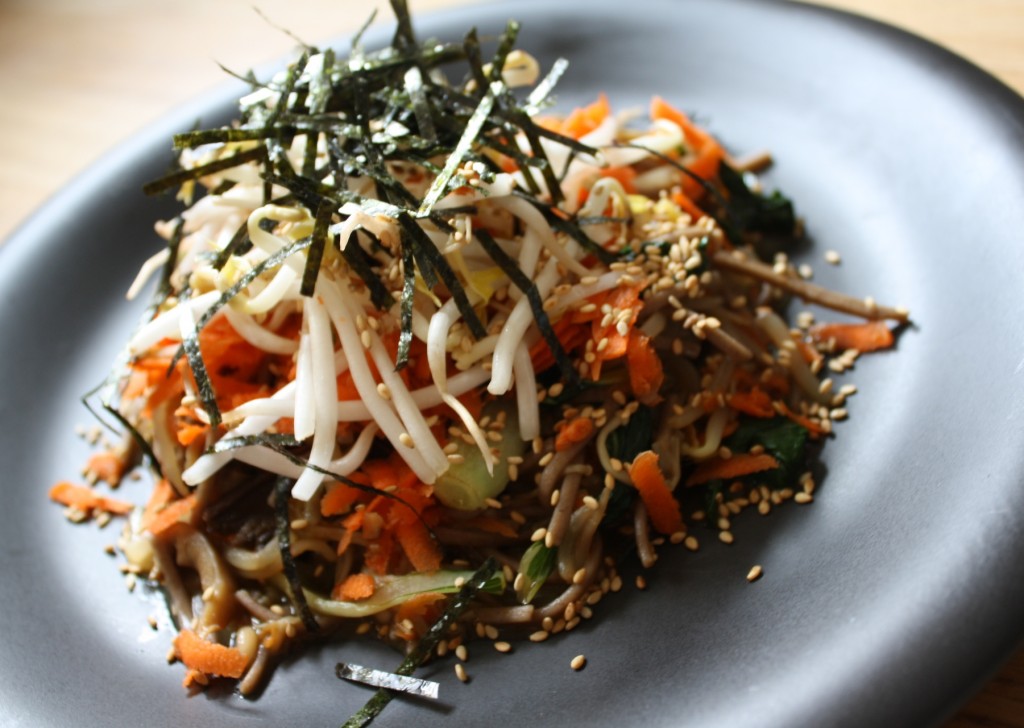
The Easy Japanese Soba Noodles formula is – (1) Boil noodles (2) Lightly sauté the vegetables (3) Toss with sauce. The measurements are not so key except for the sauce. But then you can adjust the ratio to suit your taste.
You can also play with the vegetables. This sauce tastes great with almost anything. For this recipe, I used asparagus which is so abundant at the moment. I photographed two versions of it – one with tofu and one without. Basically, this is a mix and match dish. Which is perfect because you can play with what’s on hand.
Enjoy!


Easy Japanese Noodles
Serves 6-8
8 oz. buckwheat soba
1 tsp. sesame oil
1 tbsp. vegetable oil
1 small onion sliced
2-inch piece of ginger, minced
3 cups asparagus, cut into 1 inch pieces or 6 cups baby bok choy
3 carrots, grated
1 cup shiitake mushrooms, sliced (you can use dried, soak to soften then slice)
Optional ingredients:
1 block cubed tofu, pan fried
3 cups fresh bean sprouts
Toppings:
Fresh bean sprouts, raw
Nori
Sesame seeds or Gomasio
Mentsuyu
1 2×4 inch piece of konbu (dried kelp) – can be found at your Co-Op or at Whole Foods
2 cups water
1/3 cup soy sauce
2 tablespoons mirin
1 tablespoon sugar
Directions:
1. Make the sauce: boil konbu and then simmer until stock is reduced to about 1 2/3 cup. Add the soy sauce, mirin and sugar and bring back to a boil. Remove from heat and allow to cool.
2. Boil the noodles according to package directions. When done, drain and rinse with cold water to prevent from cooking further. Toss with sesame soil.
3. In a wide pan, heat the oil then add the ginger and onions. Saute until onions soften a little. Add the rest of the ingredients and sauté until just softened.
4. Toss noodles and vegetables together, dress with the sauce.
5. Top with desired toppings.
6. Serve hot or cold.